ChatGPT Tests Visual Ads During Image Generation
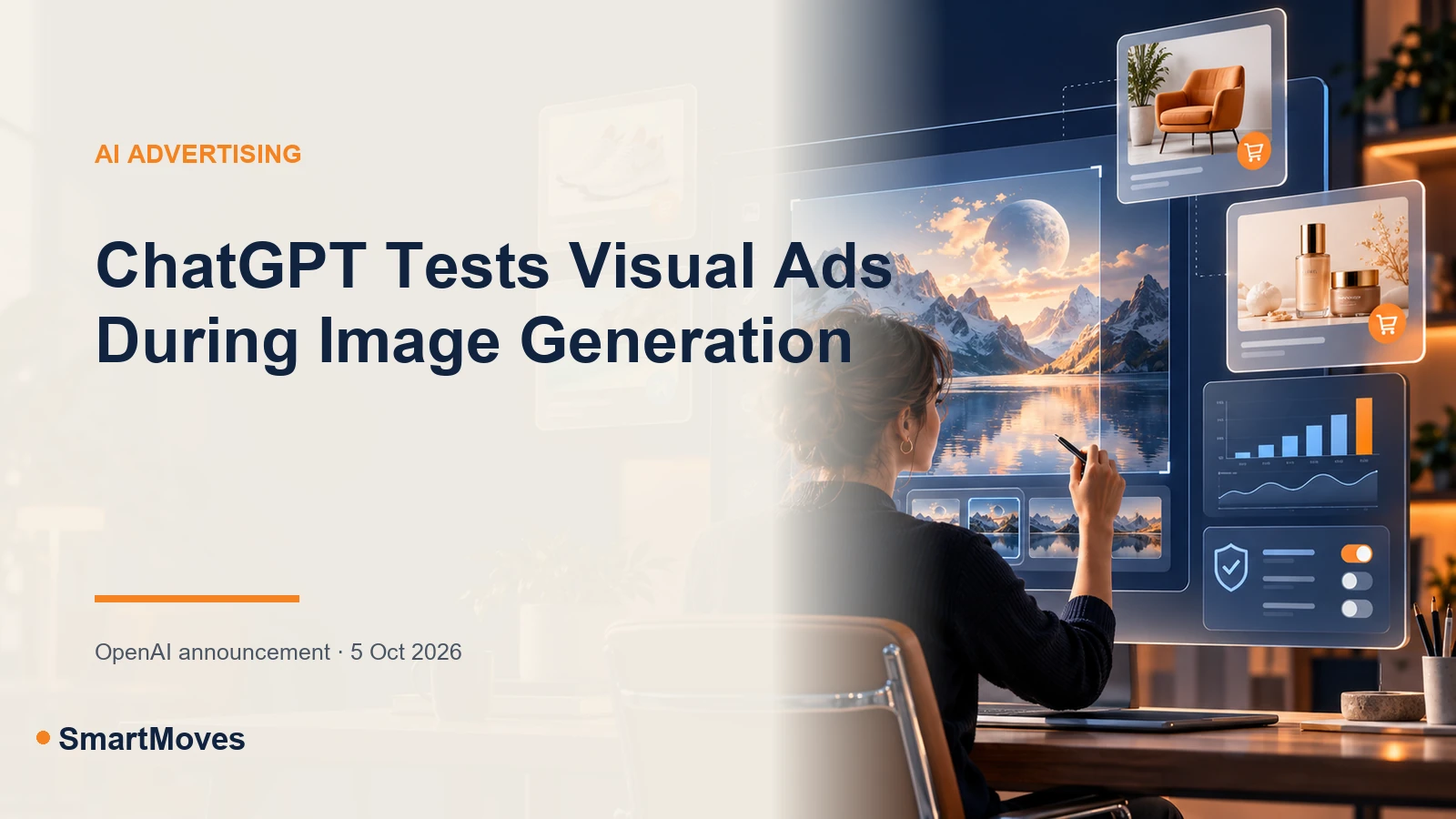
OpenAI announced a new visual advertising format for ChatGPT on October 5, 2026. The first test will place clearly labeled ads near image-generation activity. It changes where a brand may appear, but it does not mean that every advertiser or every user will see the format.
What is changing?
The new format uses images to present products, services or experiences while a person is generating an image in ChatGPT. OpenAI describes possible uses such as product inspiration, showing how an item is used or illustrating an experience connected to a service.
This placement matters because the user may be exploring an idea rather than searching for a specific product. The creative therefore needs to explain why the offer is relevant without being mistaken for the generated image. Clear labeling and visual separation are essential parts of the announced test.
The first rollout is limited
OpenAI says testing will start in the United States later in October 2026 with a limited group of advertisers. The announcement does not give a full list of eligible industries, campaign objectives, prices or international launch dates. Brands outside the test should treat the news as a signal to prepare, not as an immediately available media plan.
The announcement also states that ads remain separate from ChatGPT’s answers and do not change those answers. Paid placement should therefore be measured as advertising. It should not be treated as proof of organic AI visibility or as a way to control independent recommendations.
Measurement and brand-suitability changes
OpenAI is expanding connections for conversion data, reporting and click attribution. The named partners include Hightouch, Tealium, LiveRamp and several web and app attribution providers. It is also working with partners on full-funnel measurement and early geo-based incrementality experiments.
“Incrementality” asks whether advertising caused additional outcomes that would not otherwise have happened. OpenAI says this work is still at an early stage. The announcement includes results from individual partner examples, but it does not publish enough common methodology to use those cases as universal benchmarks.
For brand suitability, OpenAI describes automated review, human oversight and continuing monitoring. Qualifying advertisers can use Negative Phrases for narrow placement restrictions. DoubleVerify and Integral Ad Science are also involved in controlled evaluation pilots that OpenAI says do not expose private user conversations.
A practical preparation checklist
- Prepare visual assets for an exploratory moment. Show the product or service clearly and avoid claims that require missing context.
- Separate paid and organic reporting. Do not combine ad results with referral traffic or brand mentions from independent ChatGPT answers.
- Check conversion data quality. Review consent, event names, deduplication and attribution windows before sending data to a new channel.
- Define unsuitable contexts. Document sensitive topics and brand-specific exclusions before the campaign starts.
- Plan a real test. Use a comparison group or a structured geographic experiment where possible. Track cost, qualified visits and downstream outcomes over a sufficient period.
A new format can create additional discovery opportunities, but creative quality and measurement design will determine whether a test produces useful evidence. Early partner examples should be read as individual cases rather than guaranteed results.
Source checked October 8, 2026: OpenAI, “Building advertising for the way people use AI,” October 5, 2026. The announcement describes an initial US test; broader availability and comparable campaign benchmarks have not been published.